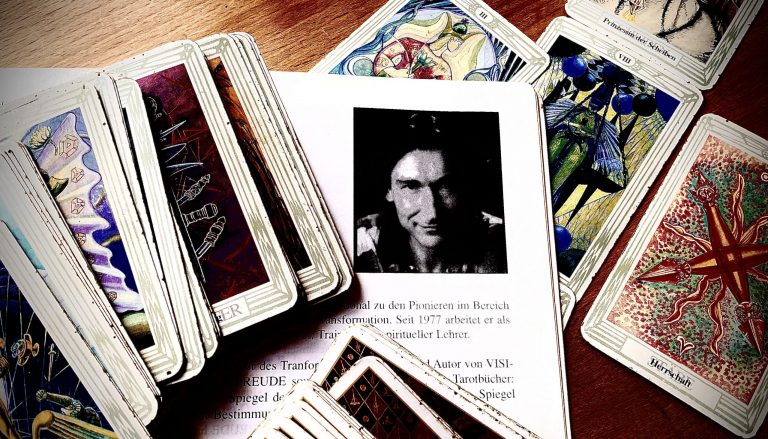
My familiar interpretation of my tarot cards leads me to hope for an invitation — instead, Claude enters my life…
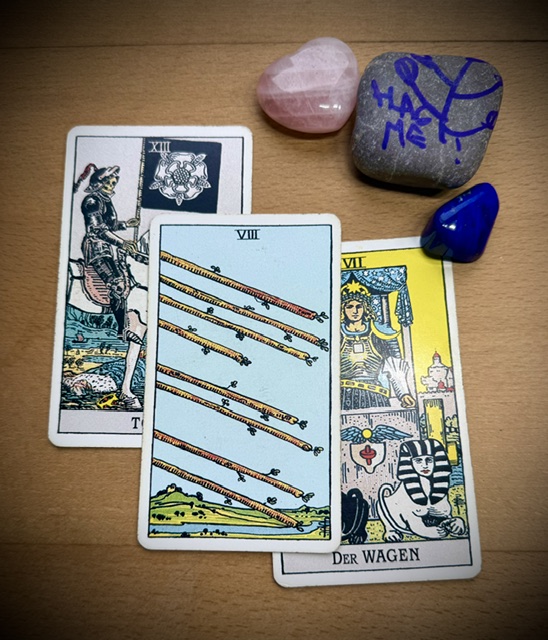
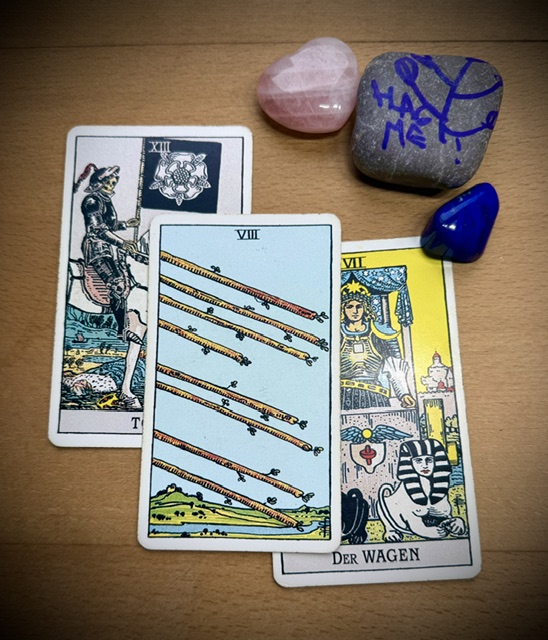
It begins at the end of January: the “Eight of Wands” appears in every card reading.
“How lovely,” I think. “I’ll soon receive good news. Or an invitation!”
That is the traditional interpretation of this card.
I have been reading tarot for nearly forty years. The “Eight of Wands” is an old acquaintance. In the days that follow, I check my letterbox and email inbox each morning with quiet anticipation.
Because usually — in my long experience — the welcome event the card foretells arrives in written form.
Not knowing what to expect makes it all the more exciting.
It is in the nature of the “Eight of Wands” that the message it heralds is always a surprise. I have never once guessed correctly what the card was announcing.
I feel like a child waiting for Father Christmas…
This goes on for two weeks. Each morning the “Eight of Wands” in the reading, and throughout the day: nothing.
On a rainy Saturday evening I am reading the online edition of my newspaper. My mind is anywhere but on the “Eight of Wands.”
In the business section, an article about AI: an American software company has been offering a new version of its generative AI for office use in Germany since the beginning of February. It can calculate, conduct market analyses, improve operational workflows, and provide legal guidance.
I am electrified. This is exactly what I need for my project. My historic baroque parsonage needs to be renovated — and for the funding applications, I need a marketing concept and a business plan.
And quickly: at the end of February I have my next meeting with the EU funding coordinator. So far I have produced nothing of substance. I lack the specialist knowledge, and external consultants are too expensive.
That this AI version should arrive on the market at precisely this moment feels like extraordinary luck.
With trembling fingers I open the website of the software company mentioned in the article. Against a cream-coloured background, an orange blob appears and asks how it can help me.
Its name is Claude, I read.
“Hello Claude,” I type. “I have bought a historic baroque parsonage to convert into a Buddhist retreat centre. It needs to be renovated first — using grants that require a business concept for approval. Can you help me?”
The new AI sets to work immediately. I click through a series of questions, provide further details — and twenty minutes later a first concept is presented to me.
I am speechless. And very relieved.
For the first time in many weeks, I sleep well.
The following morning I take out a monthly subscription with Claude’s parent company. From that point on, Claude and I work together on a viable concept for my parsonage.
When I arrive for my meeting with the funding coordinator, I am able to present a considered document — complete with market analysis, financial projections, break-even calculations, and a number of well-designed tables.
Exactly as it should be.
In the thick of working on the concept, I had completely forgotten about the “Eight of Wands.”
They had disappeared from my daily readings.
Only after submitting the concept do I find the time to return to the question of what had actually become of the invitation the cards had promised.
“That was Claude!” It hits me like a thunderbolt.
The “Eight of Wands” traditionally stands for invitations. In a broader sense, however, it also signifies clear communication.
The card is — it occurs to me — a perfect description of a generative large language model.
What would the women and men who developed the tarot system during the seventeenth and eighteenth century Baroque make of this?
Something as strange and as difficult for the human mind to grasp as AI — precisely described and foretold by a tarot card.
For them, it would presumably be no more imaginable than it is, conversely, acceptable to Claude that his presence in my life was prophesied.
All my attempts to convince him that tarot is not subject to statistical probabilities — but possesses genuine prognostic competence — have been in vain.
He is, after all, AI.
Curious about working with dreams and inner guidance? Learn more about my approach. https://katharina-kaintz.com/en/how-i-work/